Latest body / B6
A clearer path
for the pen.
The small nose is gone. A smooth inner cone makes room for another millimeter of downward travel. B6 is ready for its next physical fit test.
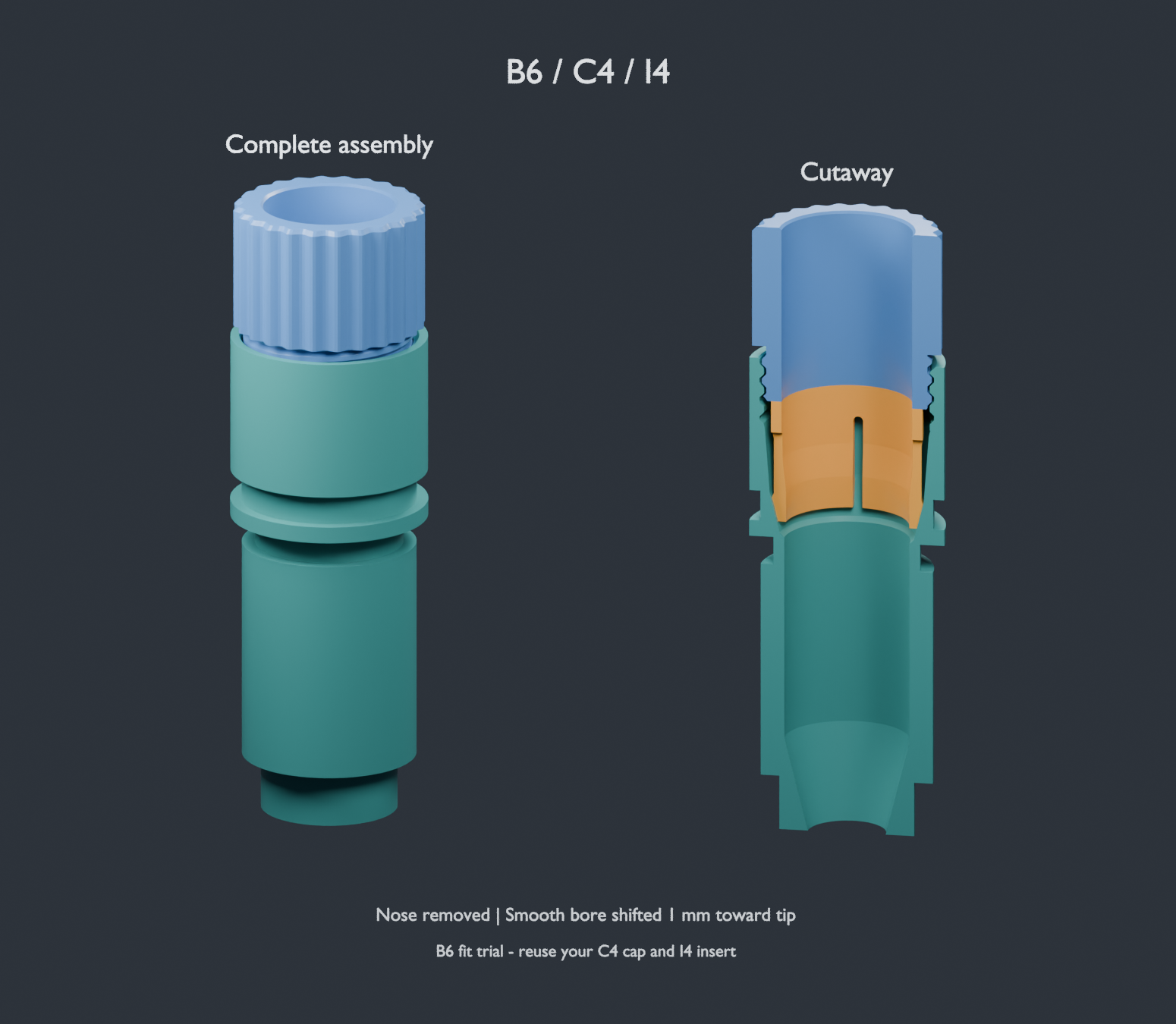
Assembly preview · enable JavaScript for the 3D view
Pen: measured 1.0 profile · shortened barrel for clarity
Remove the stop.
Smooth the way.
The previous body blocked the pens before they could reach the height tool’s pad.
The print report described holes near the small nose and difficulty lowering all three pens. After the maker removed that nose, a pen passed through, but still needed another 1 mm of travel.
B6 removes the full 3.25 mm nose. The next ring keeps its outside shape, while its internal steps become a continuous cone shifted 1 mm toward the tip relative to the nose-cut B5. The measured obstruction in the cut print is still unknown; this is a design allowance to test.
A smooth lower bore
The new outlet is 6.3075 mm across, opening into the 10.15 mm barrel passage. The remaining lower ring has at least 1.2056 mm of radial wall in the model.
The matching grip
Use C4 and I4. The carriage surfaces, flange positions, thread, and socket are carried forward from B5, so those two parts can be reused.
A new height reference
The old pad target was 4.18 mm below the removed nose face. With the flange datum retained, it is 7.43 mm below B6’s new exit face.
A changed interface needs a new check
The removed nose previously located in the height tool. Check that B6 seats consistently before using the tool to set writing height. The 7.43 mm distance is the carried-forward nominal target, not a measured B6 pass.
I3 holds.
I4 starts fresh.
The latest I3 print tightened more easily and resisted the maker’s strongest attempted hand pull.
That makes I3 the successful baseline for the earlier, larger grip. The exact companion part revisions and tested pen size were not restated, and the force was not measured.
The newer measured shell is narrower. It needs a smaller thread and a shorter, slimmer insert: C4 and I4. I4 retains the 10.05 mm gripping bore, but its changed fingers need their own physical hold-and-release test. I3 does not fit B6.
The cap is intended to grip before its band touches the body. Flush closure is not a success criterion; secure grip, release, and stable pen height are.
Reach. Seat.
Hold. Release.
The B6 body passed mesh and slice checks. No physical B6 print, all-pen fit, compact-grip result, or plotting run is recorded yet.
Digitally checked
Ready for a
measured trial.
- One closed mesh component with the B6 ID engraved into the solid.
- The lower passage preserves at least 1 mm extra nominal travel against the checked profiles, compared with nose-cut B5.
- A support-free A1 mini slice completed without reported warnings; the B6 label is present in wall paths.
- C4 and I4 files are unchanged from the matching compact mechanism.
Check at the bench
Separate each
fit question.
- Inspect the printed lower ring, bore, and upper contact ledges before fitting a pen.
- Try each pen gently with the cap loose. Check passage and reach without forcing the tip.
- Confirm repeatable height-tool seating and stationary carriage clamp contact.
- Tighten C4/I4, test grip and release, and remeasure writing height after tightening.
Record the printed part IDs and pen label with each result. Earlier V17 notes used 0.005; a later projection report used 0.05. That label difference remains unresolved. A successful I3 hand test does not establish I4 grip, durability, or universal plotting performance.
B6 + C4 + I4.
Print just B6 if you already have C4 and I4. Each part carries its ID in the exported solid; earlier revisions stay available in the project journal.
Print orientation
B6: large screw opening on the bed, smaller outlet upward. C4: wide grip band down, threaded stem upward. I4: closed band down, slotted fingers upward. Use millimeters at 100% scale.
The recorded B6 slice used an A1 mini, 0.4 mm nozzle, Generic PLA, 0.16 mm layers, four requested walls, 15% infill, a 3 mm brim, and supports off. Estimated body time: 40m45s; material: 3.03 g. Thin regions may not fit four wall loops.
Read the complete test guide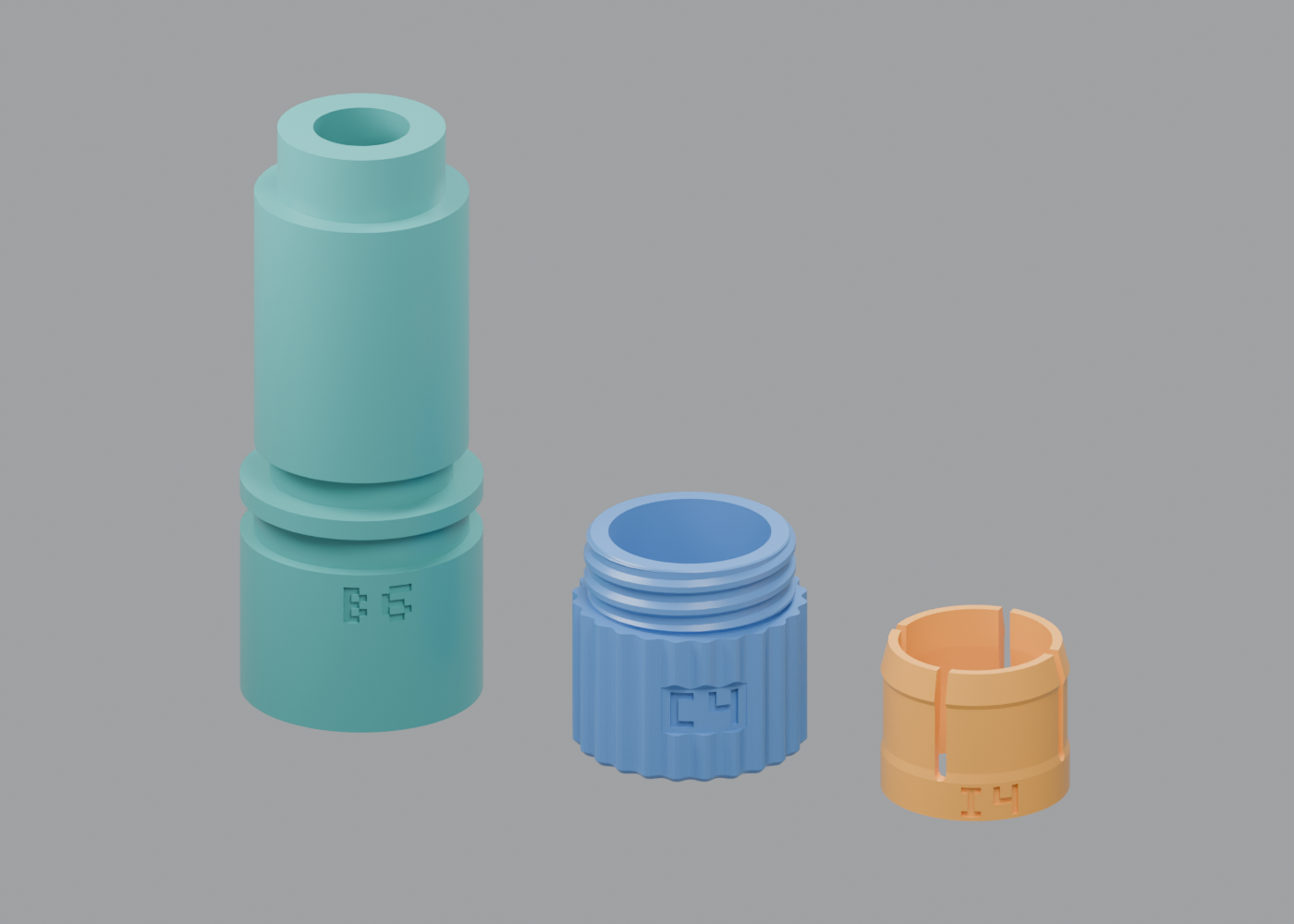
Checks establish digital preparation. Physical print quality, tool seating, grip, and writing still need observation.
Browse the full iteration history